Monday, March 17, 2014

Taken for a ride - part two

As a follow up to my post about the demise of public transportation in United States, here is an article about the history of our cities - how we lost the streets for cars and how crossing freely anywhere we wished became illegal jaywalking. Worth reading and worth remembering how
"At some point, we decided that somebody on a bike or on foot is not traffic, but an obstruction to traffic." 
Sixth Ave in 1903, New York City. People ruled the streets and public transport was a dominant way of travel. (Source: CollectorsWeekly.com)

Most countries followed U.S. example and opened their cities for cars, pushing people off the way, onto sidewalks. Few tried to fix the problem. Obviously the best example of one of those few is Holland, where some time in the 70's the Dutch realized that the best way to avoid having their cities plugged permanently with a slow moving car traffic is to take the streets away from the drivers and give them back to pedestrians and cyclists. It worked! Dutch cities are often quoted as the most walkable in the world.

Meanwhile in the U.S. traffic congestion is growing three times as fast as U.S. economy but we are still too afraid to make driving unappealing and stimulate drivers to to switch their cars for other means of transportations. On the other hand, we demolished our streetcar lines back in the 40's so there are few alternatives left. Are we just destined to be car-dependant forever?

Thursday, March 13, 2014

Spring time?

Looks like the warmer weather has finally arrived. At least for a short while (We had another snowfall today). Snow is melting and somehow more cyclists start to show up on the streets. Many of which will quickly realize that "fender season" is now in full swing.
I generally avoid Minuteman Trail and other bike paths in winter since they are at the opposite end of I-95 when it comes to snow plowing priority. But as Tuesday's weather was just so warm and inviting, I decided to take a longer route back home and try to ride on the bike path instead. Unfortunately, while Minuteman Bikeway looked mostly clear and free of snow, you couldn't tell the same about the Lower Vine Brook Trail:
And this means that I was a bit too quick. Yes, spring is slowly coming but it's not here yet. I will have to wait longer and until the snow is gone for good. For now, I stay on the road, with cars.

Monday, March 10, 2014

Taken for a ride - how Americans ruined their public transportation

This is a story from the beginning of the XX century. A story about the American cities, where driving was a privilege and cars were rarely seen on streets. Highways did not exist and most people were using electric streetcars, running on rails, as their main way of moving around the city. In 1920, 90% of all trips were via rail and only one in 10 Americans owned an automobile.

This is a story from the late 30's. A story when large corporations such as General Motors, met with political power with a goal to sell more cars to Americans. To make this successful, American cities had to be transformed and people had to be convinced that rail transport is the way of the past and cars are the future. The rail companies started to vanish and with them, the streetcars and rails. Buses and cars took over the streets and American cities became noisier and more polluted.

This is a story from the 50's and 60's. A story about the vast network of freeways that started to cut through the American landscape and surround largest cities like giant spider webs. The freeways cut through the neighborhoods, separating people and transformed massive amount of space within the cities. The I-93 highway in Boston required resettlement of 4000 people and relocation of part of the Mystic River. Many cities followed this example.

This is a story from the 70's. A story when people started to realize that urban sprawl and car dependence is not the answer but a problem. The cities were not designed to accommodate a quickly increasing number of vehicles and mile-long backups on highways were an integral part of each day in America. An alternative would be a welcomed option but it was already too late - the damage was done. Streetcars were gone and busses had to share the same roads with cars, making this public transport lacking and inefficient. 

The story continues. Today, America is as car-dependent as it was back in the 70's. The old problem is not solved but more and more people seem to notice the issue. Can America recover from the damage done over the decades? It will take time.

***

I have to admit that until I found this movie, I haven't thought about this at all. Cars are so well incorporated into American culture that I assumed this was always the case. But the truth is so different. America had an efficient and effective public transportation. A system that was completely dismantled with a decade and replaced with a nightmare we have to deal with until this day. Only a fraction of the old streetcar system survived in some cities and whether GM is to blame or not, Americans ruined their public transportation and what we have left is this:
Streetcar/subway rail system in Boston.

instead of something like this:
Streetcar/subway rail system in Berlin.

Friday, February 28, 2014

A mixed update

I kept reading the news this week and there seemed to be quite a bit of information I dug out that I found worth mentioning here.

First, Dave Moulton wrote an interesting essay on rights and privileges. So if you want to understand why "driving is a privilege, one that can be taken away, whereas cycling like walking is a right", go on.

***

Next, remember when I mentioned the unique Infinity Seat a few months ago? I wrote that the giant prong in the center of the saddle looked like asking for an ass-trouble. Now, the idea of riding with a saddle deep in your buttocks has been taken to the ridiculous level. Shark Saddle is clearly the most idiotic bike bicycle-related invention I have seen recently. But if you look for some anal stimulation on your ride, go ahead and try it.
Shark Saddle (Source: bikebiz.com)

***

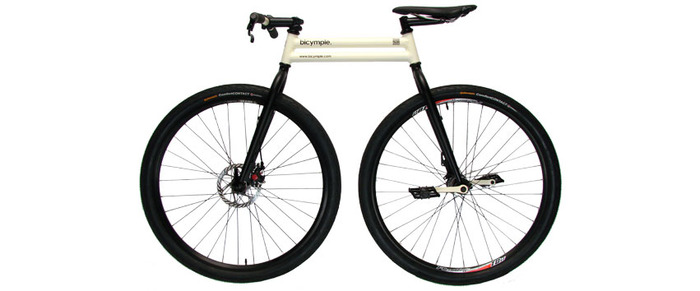
Kickstarter is full of some really weird ideas and at first I thought that Bicymple is just one of them. A short-wheelbase bicycle with both wheels steered looks clearly nothing like ordinary. After watching the video I realized that this thing is actually rideable and probably makes sense. Still, I think that the market for Bicymple is just not going to be huge.
Bicymple (Source: kickstarter.com)

***

The next thing is not really news anymore because this was news over a year ago. Or even much, much earlier. But it's an interesting fact worth noting - American teens don't drive. That is - not as much as teens in earlier generations. Roughly from the late 80's we have seen a steady decline in the number of new driver's licenses issued to young people every year.
Teens drive less (Source: nationalgeographic.com)

This is a "new" problem to have for all car manufacturers and there are four reasons for this phenomenon discussed in the article. Teens don't drive because with cell phones and Internet access everywhere they simply don't have to (1), they don't drive because in tougher economy securing a higher-paid job and being able to afford a car is increasingly difficult (2), they don't drive because they don't want to and prefer to use bicycles or other means of transportation (3), and they don't drive just because they are too busy to find time to get their licenses (4). Whatever the truth is, the article is an interesting read.

***

And the last thing today is the story of Stanisław Królak (Wikipedia page, in Polish!), someone you probably have never heard about. I was reading a story about this cyclist a few days ago and it made me think how much different professional cycling in the 50's and 60's must have been. You see, back in the 50's when the Western Europe had their Tour de France, the communist Eastern Block had their own Peace Race, which was "very different" than those imperialistic bicycle races in the West since Peace Race cyclists were "strictly" amateurs. Yes, I used quotes twice, but that's because those amateurs being simple working-class miners, farmers or lumberjacks had never seen a mine, farm or a forest, respectively. Even though they were called amateurs all they did year round was to train for the Peace Race. Which makes them no different than Tour de France cyclists.

Anyway, Królak was the first Pole to win the race, which happened in 1956. Interestingly, the race tactics at that time was drastically different than what we see on TV today. When the leading cyclists were entering the stadium for their final lap and finish they had to ride through a short tunnel. This was the only place during the race where TV cameras and radio reporters couldn't see them. And since all of them carried bicycle pumps, they used them as weapons, whacking each other. Now keep in mind that bicycle pumps in the 50's looked more like an iron gas pipe, than those lightweight mini pumps we use today so you can picture the damage a solid whack in the head could do. The tunnel fight of 1956 was won by Królak and Soviet cyclists who often used the same method during earlier races lost the leader's jersey that time.
Stanisław Królak on Warsaw's stadium (Source: Wikipedia.org)

Friday, February 21, 2014

Oops, I live in the wrong city!

This was news a few days ago so you may have heard about the Massachusetts’ Department of Conservation and Recreation response to Boston cyclists asking for removing snow from bike paths:
I am tired of our dedicated team wasting valuable time addressing the less than .05% of all cyclists who choose to bike after a snow/ice event (...) If someone is completely depending on a bike for year-round transportation, they are living in the wrong city.
Looks like I live in the wrong city. Yes, my city caters to drivers in winter, not to the "0.05%" of cyclists who bike despite the snowfall. But my city doesn't even cater to majority. If they did, they would've  been plowing sidewalks first and pushing all that snow from sidewalks into the traffic lanes, not the other way around.
 
After the 2 or 3 (I lost the count already) snow events last week, I started wishing that the city would not plow streets in winter at all, just compact the snow with snow groomers. Obviously when there is a lot of snow this may not be the best idea but not only the city would look much prettier. This would also force all drivers to slow down and finally learn how to drive.

Meanwhile, since we can't count on the city (or our smaller towns around Boston), we have to do it ourselves:

Tuesday, February 18, 2014

Waiting for the spring

Not much going on recently. We had another Mukluk day last Thursday, then more snow yesterday, with even more coming this afternoon. More and more often I keep hearing people saying "I can't wait for spring".

While I don't mind this winter at all and I don't think it was much worse than any other Boston winter in the last 10 years, I am waiting for the spring as well. I think I miss those longer days and drier roads with no more crusty salt topping.
 
Meanwhile, back to watching the Olympics...
Winter Cycling Olympics (Source: yehudamoon.com)