Wednesday, March 7, 2018

Parkland and Park Slope

On February 14 this year, Nikolas Cruz entered Stoneman Douglas High School in Parkland, Florida and started shooting his classmates with AR-15 rifle. He killed 17, injuring 16 more. It was yet another of hundreds of mass shootings in the last decade in United States and one of many this year, even though 2018 has just barely started.

But one thing turned out to be very different this time. Students spoke and started a nationwide outrage, much more pronounced that during any previous shootings. As a result, the debate over smart gun control laws is back in Congress, several major firearm retailers changed their rules of how and to whom they sell guns and many companies ceased their discount programs for NRA members. We have never seen that level of change in such a quick time before Parkland shooting and everyone hoped that perhaps the youngest generation will trigger Congress to act smart this time.

America has a long history of deadly mass shootings due to our undisputed love of the Second Amendment, lack of any serious background checks and regulations and inability to treat mentally unstable citizens. Not to mention - military-grade weapons are seen as "toys for boys" that apparently you have a right to own. Even if you are mentally ill.

As such, tens of thousands of Americans are killed by firearms every year, but at least we, as a nation see it as a problem, even though some of us aren't willing to offer more than just "thoughts and prayers". There is however another cause of death in America that gets virtually no media coverage, even though it results in higher death numbers year by year. I would call it - murder by car.

Our roads are dangerous to everyone outside of the reinforced metal box, our cars became in the last decades. Long years of road design that focuses on drivers and speed, not those vulnerable users - pedestrians and cyclists, lead to over 33,000 dead every year. On top of that is the American licensing system with its very lenient rules and general inability to exclude dangerous drivers from being part of the traffic.

The most recent tragic example came from New York City, where 2 children were killed and a pregnant woman severely injured when driver ran them over in a crosswalk, ignoring the red light. The driver, 44-year old Dorothy Bruns was not arrested (as this seems to be a norm in such situations, especially in New York), but her license was revoked (unfortunately, much too late) after a massive outcry following this collision, once it was discovered her car had 12 traffic violations on record, including speeding and running red lights. On top of that, she was found to have a history of seizures, multiple sclerosis and heart failures - conditions that should not allow her to drive in the first place.
Such traffic collisions happen every day on American roads. And every day police usually dismisses the case, doesn't arrest the driver nor even issue a citation and media quickly call it yet another "accident". Next, we move on, forgetting about victims and not even trying to pause for a moment and think - why are these deaths so frequent? What causes them? Where is the source of the problem? What can we do to stop it?

Similarly to gun ownership, driving is such a well-established part of our life that we generally tend to accept any collateral damage it causes, no matter how tragic it would be. Seeing all this you may think, it's good that cars were invented over 100 years after foundation of the United States of America. Otherwise, our Founding Fathers would probably add "a right to drive" to the Constitution.

Unfortunately, any change will be a difficult one. Not everyone owns guns yet everyone understands danger they pose, which is why it's easier to petition for gun control laws. But, at least here in America, nearly everyone drives and therefore, it's so much harder to impose any restrictions on what most us see as our "right" and a seemingly safe activity. That makes solutions such as congestion pricing be extremely unpopular as that would affect every one of us, not just some remote "guy with a gun" somewhere in Montana.

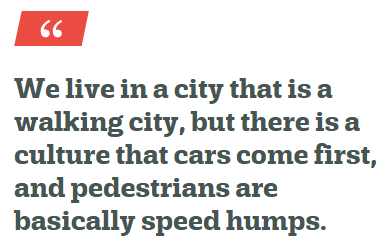
It became clear that we need to change our streets, making them safer, slower and more friendly for pedestrians and bicyclists. It's clear that we need to end our reliance on cars and built efficient transit systems. It's clear that we need to revise our licensing system to keep people who should not be allowed on roads, not to drive. And finally, it's pretty clear that we need to reform our police and ask them to truly "serve and protect", not to catch people on e-bikes or ticket jaywalkers. Probably the best summary of the problem was given by one of the NYC citizens who confronted Mayor de Blasio the day after the event:

Basically, we need another #NeverAgain campaign (hashtag used by Parkland shooting survivors to promote their call for change) and it shouldn't be the #VisionZero. In fact, there is no need to reinvent the wheel - the Dutch did that for us back in the 70's. Their "Stop de Kindermoord" seems very appropriate. Now it's time to implement it here in America and stop #murderbycar.

Wednesday, February 21, 2018

Is it over yet?

I've been taking a short break from blogging recently. In the time of my absence all sort of random things happen - a couple new mass shootings, a few hundred more people died in car collisions, a car flew into outer space, Boston went into a week of mourning after lost Superbowl, and finally - summer weather arrived - even though it lasted only 2 days. You know - just typical things you would expect to happen in February in United States.

Anyway, some things need to end so others can start. This winter I've been using a "new" bike for my daily work commute. It's actually my 10-years old "long-distance tourer", or whatever the most appropriate name is, just converted this time to a flat bar all-weather rig. This means - drop bars are gone, fenders are in, front rack is installed and a new drivetrain is now in place. I switched from 2x10 to 1x11. Less gears, same range and more than enough I need for this type of riding.

A post shared by Dr J (@drj.bbb) on
All this means that now I don't have a dedicated travel/touring/exploration bicycle anymore... but that's temporary. Something new is coming. Hopefully soon.

Meanwhile, I'm waiting for spring to come and I hope winter is not coming back because I've just replaced studded tires with normal ones.

Saturday, January 27, 2018

16 Seconds

It's been over two years since Dr. Anita Kurmann was killed by a semi truck while riding her bicycle to work in Boston. And just like in virtually all other similar cases, police didn't press any charges and quickly closed the investigation, concluding that it was just another traffic "accident".

But as we know now, traffic accidents rarely happen. They're not caused by some higher power but by someone's distraction, lack of control or other human-dependent factors. As such, it's hard to accept someone's death (especially if that someone is your close relative), merely as collateral that we need to pay in order to keep the system going.

MassBike decided not to let Kurmann's death be forgotten and ran their own investigation. Results were published earlier this week. Usually, it's difficult to know what happened shortly before such a tragic collision, but this time we have a video showing exactly that.
Everyone's take on this may be different but you may notice various little details, such as:
  • Truck driver (Matthew Levari) had Kurmann in rear view mirror for 16 seconds - i.e. plenty of time to notice her, before he actually executed the turn.
  • The truck moved slightly left before turning right - a maneuver necessary for such large trucks to make tight turns, but also something that might have fooled Kurmann thinking the truck wasn't really about to turn right.
  • The truck had turning signal on, which Kurmann should have noticed (and maybe she did).
The video shows that Levari clearly broke Massachusetts law that strictly prohibits turning in front of cyclist who we just passed ("right hooking"). He essentially operated the same way as most truck drivers operate - with general disregard to many other road users. I noticed that myself many time while riding my bike - truck drivers control very large vehicles and as such feel empowered to "own" more of the road, consciously or subconsciously intimidating others with sheer size of their trucks. It's basically a straightforward approach - "you better pay attention to me and give me space if you don't want to be hit, as I may not pay attention to you".

Having said that, I have to also say that Kurmann made a mistake too and it costed her her life. Whoever rides bikes in the city knows well that whatever you do, you stay away from large trucks and never ever get between them and the curb. It's generally much safer to either let them go first and stay far behind or, if they're stopped, get far ahead of them to make sure drivers can see us. The spot where Kurmann ended up - right mid-way of semi's length, was the worst possible place should could've been.

There is also a question whether such giant vehicles should even be allowed in downtown Boston, which reminds me about another incident that happened recently on the other side of the globe, in Australia:
There is clearly a lot of wrong about that trucker's behavior as evidenced by his own video, but let's try to understand why he hates cyclists so much. He said:
"I've driven trucks for 16 years and I have been in situations where I'm trying to slow a 64.5 tonne truck when there's a truck coming the other way, and bike riders are the object I have had to miss. Another truck has ran off the road for that."
All this makes me think that clearly heavily-loaded semi trucks are difficult to stop effectively in a short distance, which raises a question whether they are inherently unsafe to be even allowed on many roads in the first place?

Finally, I want to focus on something else here - our police. Dismissing the case before even reviewing all evidence is unacceptable. Letting driver go without even a citation is unacceptable. Calling it merely an accident is unacceptable. For some reason, our police seems to pay more attention to road collisions involving two motor vehicles than those involving a pedestrian or a cyclist and a car.

This problem is much larger than Kurmann's death. It's a systemic problem that our police treats certain road crashes as more worthy a detailed investigation than others. Just like they seemingly treat some people as less important than others.

Police ranking of importance of road users looks essentially as follows:
  1. VIPs in their cars - the most privileged group
  2. other white people in their cars
  3. white people on bicycles
  4. people of color
  5. people of color on bicycles - the most "hunted" group, since not only they're not white, but also perform an activity considered to be "not normal" in America - they ride bicycles
 As Angie Schmitt from usa.streetsblog.org noticed:

Obviously, I don't know much about it as I'm white as arctic snow, but I think Angie is right. Riding a bicycle in America is something little kids do. Adults have cars. Adult on a bicycle is still considered abnormal in many parts of the country and if that person happens to be non-white, he/she is quickly targeted by police. By the same standard, if this person gets killed in traffic collision with a car or truck, police favors blaming the cyclist as the one "weirdo" on road who "was asking for trouble". As Angie points out:
We learned to accept death by vehicle the same way we accept mass shootings - it's apparently a part of American folklore - something so established that we can't imagine living in a world where such things just don't happen. In America, we call it freedom. Everywhere else, they call it stupidity.

Tuesday, January 9, 2018

Boston after snowfall - a giant middle finger to all cyclists and pedestrians

Who's afraid of the big, bad snow? Boston's Department of Public Works, for sure! This happens pretty much every winter season - when it comes to plowing, traffic lanes get priority while many sidewalks and bike lanes remain forgotten for weeks... waiting for spring to come and snow to melt.

The situation is not pretty as many excellent examples found on Twitter show. What can we learn from it?

Create a free storage space and it will get filled. Sometimes you may wonder how many cars parked in on-street spots in Boston get used on daily basis. Normally, it's not easy to figure that out without careful observation, but snowfall makes it easy:
Apparently, it's more than you may think. Many cars don't get moved everyday. They just park there for days, occupying expensive street real estate that could be used by others.
***

Bike lanes are excellent... for storing snow. Everyone was so excited in the summer when new bike lanes were built in Boston. Unfortunately, half a year later we can clearly see what this space is best used for - snow storage. It's just seems so easy to push all the snow away from the street and parking spaces into bike lanes. No one uses them anyway, right?
And even if you wanted to, you'd better learn how to ride your bike on top of a giant snow bank:
But at least it seems that DPW has a sense of humor, requiring cyclists to ride in the bike lane buried in snow:
***

Safe route to school is best taken in snowshoes and traction cleats. Otherwise, how do you expect your kids to cross huge snow piles and not break their legs on patches of ice?
***

If you want a snow-free sidewalk, shovel it yourself. Don't count on DPW even though it's their job.
***

Walk in the street just remember that "cars are going to hit you". At least that's what our mayor said. Considering how Boston treats its sidewalks, I'm guessing that "may use full lane" should apply also to pedestrians.
***

That's all folks. Welcome to the city of "a car guy"!

Thursday, January 4, 2018

Viking biking in New England?

I'm sitting at home, writing this and looking through the window at snowflakes dancing in the air. It's the snowstorm time. My workplace is closed. Roads are empty. Some snowplows pass by once a while. If you take a walk to your local supermarket you will find empty shelves and a few bored employees inside. This happens every single year in New England and every year we react the same way - with near panic, buying everything from store shelves like the Armageddon was coming.

Surprisingly though, it's also the best time in winter to ride a bike in the city. Overwhelming majority of American drivers don't like driving in snow and in fact, don't know how. Learning how to drive is not a requirement of driver licensing system here. Odd.

This means that when streets are completely free of traffic, they are also safe and as long as you are prepared to ride during snowfall, there is no reason you shouldn't.

Winter cycling is often called "Viking biking" - a catchy term first used by Mikael Colville-Andersen, I believe. Copenhagen has an impressive number of winter cyclists that puts to shame any other city in the world. People ride their bikes there not because they want to, but because it's simply the fastest type of transportation between two points in the downtown. Of course, Copenhagen made this happen by not only designing a vast network of protected bike lanes, but also properly maintaining them in winter. As such, while we in Boston use bikes with studded tries to get through those barely cleared bike paths, citizens of Copenhagen can ride on blacktop lanes using pretty much any bike they like.

Would I like to see this type of infrastructure here in Boston? Of course! But do I think that once we build it, we will see the same percentage of people on bicycles in winter months as there's in Copenhagen? I don't think so. That's because there are two more factors that need to be considered.

First - the weather. Comparing with Boston, Copenhagen enjoys relatively mild winters. Yes, temperature can drop to 15F (-10C) but that's quite rare. And while it rains and snows frequently in Denmark, it doesn't usually dump 2-3ft of snow overnight onto the city. In Boston however, the situation is quite different. I've been living here for the last 15 years and I remember maybe only 2 winters in that time when temperature didn't drop to -4F (-20C). It seems to be guaranteed in January just as winter blizzards are in our area. This doesn't mean you can't ride your bike in these conditions. But no matter what you say, there will be a significant number of people who will refuse to ride bikes when it gets this cold.
Second - the distance. People in Copenhagen use their bikes predominantly for short-distance trips, 2-10km long (1-6mi), and that's not a typical distance of an average American bike commuter. My ride to work is 10mi (16km) long and that's not long by American standards. Combine that with 0F weather and you may not find many enthusiasts who would want to do it, even if infrastructure is perfectly maintained.

I'm not sure Viking biking will ever gain popularity in New England but it would certainly become more common, at least on short distances, if we invest in building and maintaining a proper network of bike lanes. Nevertheless, there is a lot to like about cycling in winter. You should give it a try!

Friday, December 22, 2017

This year is done and it's time to move on!

This year is close to an end and 2018 is just around the corner. I don't know about you, but here are just a few things I wish happen in 2018:
  • This winter ends in March, not April.
  • I go for a week-long bike tour.
  • Congestion pricing is introduced in Boston Metro Area.
  • Newbury St and Hanover St in Boston are permanently closed to private vehicles and become bike+ped only zones.
  • There is a dedicated bus lane on Mass Ave all the way from Arlington to Harvard Square.
  • Parking minimums are dropped in Boston. Also, parking maximums are now in place.
  • It costs now $200/y to get a resident parking permit in downtown Boston. Second car permit costs $500. Third and more cars per household are not allowed.
  • No school drop-off by car is allowed anymore.
  • All mandatory helmet laws are lifted.
  • Shimano introduces a road groupset for the "unwashed masses" with 44/28T crankset and a 11-32T cassette. Also available in polished sliver finish.
  • Jagwire makes cable+housing kits that are actually designed for road bikes with disc brakes, so I don't have to buy two of them because the front cable is too short to reach brake caliper.
  • Senate passes a bill requiring all bicycle headlights used within the city limits to have horizontal beam cutoff to avoid blinding other road users. Also, strobe headlights are banned. This is modeled after German StVZO.
  • Elon Musk admits his tunneling idea was a brain fart and starts building a fleet of fast electric streetcars, buses and high-speed trains.
  • Lobbying, aka "legal bribing" becomes illegal in United States and is ruthlessly enforced with huge fines and imprisonment.
  • The president and vice-president resign and move to Florida to play golf full-time.

Wishing you all Merry Christmas and a Bikey New Year!
May Yehuda brings you lots of presents this year!

Friday, December 15, 2017

DIY - refinishing bicycle components

Sometimes you have to take matters in your own hands. As I wrote a while ago, I'm not particularly fond of the decision of major bicycle components manufacturers to offer their products exclusively in black finish. Too often we are left with little choice and if you are looking for a particular part for your bike, you can have it in black... or not have it at all. Typically, hubs, pedals or headsets are offered in multiple colors but handlebars, cranksets or even worse - derailleurs, are usually black only.

Because I'm working now on a new bicycle project, I need components that are not black but polished silver. That turned out to be quite difficult, especially considering some limitations I have to deal with. Therefore, I decided that if component makers are unable to provide what I need, I have to make it myself. Sort of.

The parts I want to use on my bike but don't have silver, polished finish I'm looking for are:
  1. My old Sugino OX601D crankset and chainrings. They are silver but with dull, bead blasted finish.
  2. TRP brake adapters (and all other adapters too). Come only in anodized black.
  3. Shimano RD-7800-GS 105 rear derailleur. A modern rear mech that's 11-speed compatible and comes in "silver" option... with a  black pulley cage.
The plan was to strip off black anodizing, sand and polish surface enough so it looks nearly mirror-like. Normally, you would want to use a tumbler or vibrating polisher to this type of work but since this equipment can be pricey and I have no access to it, I had to rely on less high-tech methods to get the finish I was looking for.

Fortunately, I have some work space in my basement and access to several handful tools. I found out that the best procedure is the following:
  1. Bead blast off all black anodizing.
  2. Sand with 400 grit paper.
  3. For tight corners use cushioned paper or pads. Those hard to reach areas can be sanded using steel brushes on Dremel tool (Very gently! Dremel is a high-speed tool and will erode aluminum surface if pushed too hard). 
  4. Sand with 600 grit paper.
  5. Sand with 1000 grit paper.
  6. Sand with 1400 grit cushioned pads. At this point parts will already have nice shiny finish.
  7. Polish with buffing wheel and emery compound.
  8. Finish with buffing wheel and white rouge compound.
My Sugino cranks in their original finish.

And after hand polishing. Minor scratches are still visible but overall I'm quite satisfied with this result.


This process takes time and patience but results are rewarding. I have now polished parts I was looking for. The original finish is gone and most tiny scratches are nicely blended in. This could be likely taken even further going down to finer grit sanding paper but I think it's unnecessary. These are bicycle components after all. They will get some new scratches in normal use so it's a bit pointless to make them look like a clean mirror.

Time to put it all together.