Monday, April 30, 2018

In search of the unpaved - Mass Central Rail Trail

Rail trails - a side effect of America's defunct railway system. Now, a great way of building long-range recreational trails on a budget. Some cyclists love them, others - not so much. Yes, they can be boring. They are built in place of former railway after all, which means they are flat and often with long, straight sections. I actually don't mind rail trails as long as (1) they remain unpaved and (2) scenery along the trail changes frequently.

This weekend I decided to give rail trails another try and visit Mass Central Rail Trail (MCRT) between Rutland and Templeton. It's over an hour drive from Boston Metro Area so getting there by bike from your door step is probably not an option, unless you happen to have a lot of time. My main motivation was to give my new bike a spin over a longer, unpaved section and see how it rides in rougher terrain. The planned route was 70km (44mi) long and more importantly 85% unpaved and that should give me a good feeling of how the new bike handles.

The route. Red sections are unpaved. Blue are paved.

I started at a small parking lot just at the trail head on Glenwood Rd in Rutland. It was raining heavily the previous night and as such, morning was soggy and foggy. I moved quickly along the trail, which along its southern section between Glenwood Rd and Rt122 resembles an unpaved cycling highway. It's graded well, smooth and overall very "civilized". I met a few joggers and dog walkers on the way, likely due to proximity of Rutland.
But if you think that the full length of trail is going to be that easy, you would be mistaken. Once you cross Old Worcester Rd and enter the trail section running straight north, conditions change quite a bit. Clearly, this part of MCRT is used mainly by snowmobiles in winter as it remains much more wild, muddy, rough and... empty. During the next 20km (12mi) all the way to Templeton I didn't see anyone on the trail. Or maybe it was the foggy weather that scared locals off?
Once I got to Covered Bridge Rd I went off the route for just moment to find out whether the bridge was still there. A look at Google Maps a day earlier told me that it likely wasn't going to be the case and I would need to find a different route on the way back. Unfortunately, Google Maps was right. The old covered bridge was missing, as well as another bridge at Lackey Lane, just a bit further north. At this point I knew I would have to stick to Plan B and go Granger Rd on the way back.
The rest of the ride to Templeton was uneventful - just a few more miles along the mostly straight and very flat trail. Since, as I mentioned earlier, this part of the MCRT is more wild, I had to cross several muddy sections and some with pretty deep sand. Rolling on 2.2" wide tires certainly helped a lot. I would had to fight it really hard, had I been there on my old bike with "skinny" 35mm tires.
Crossing Burnshirt River. Seriously, who came up with that name?

Once I got to Templeton it got warmer, sun was coming out and for a moment I thought that it would get hot. But the next section was a mad downhill ride on Rt101, which quickly reminded me it wasn't the right time yet to take the jacket off.

The next section of the route ran along Williamsville Rd, which is unpaved but starts as a very hard packed, smooth street, only to turn into a muddy forest fire road later on.

The real fun starts a bit later though, once you enter Gilbert Rd and then Granger Rd. Both are rocky, rough, with some steep sections. In other words - perfect testing ground for my "mountain road bike".
Granger Road in late morning sun.

The rest of the ride was just a fairly typical mix of short paved sections, wide forest fire roads, some rough double-tracks and a few rocky paths. Exactly after 4 hours on the bike I was back at my car and now I think I would need to pay a few more visits to western Massachusetts pretty soon.

Friday, April 20, 2018

Tech talk: The newest tech that you do(n't) need

Just to give you a warning - this will be a part about some recent bike tech with lots of "my opinion" and "what if" scenarios.


Ah, the ever-changing bicycle tech. Manufacturers who always try to sell us the best and the newest certainly keep us entertained. And since "best" is the worst enemy of "good" - this process will never stop, for sure.

There is a lot going on in bike industry but since I'm mainly interested in, let's call it - mixed terrain riding, I'm going to focus on news from the rapidly growing "gravel" bikes market.

So let's start with the elephant in the room - suspension. Technically, your road bike doesn't need suspension. If you ride on rougher roads and you think you need suspension - just put much wider tires on your bike and be done with it. But since there are some people who believe that riding on unpaved roads on a non-suspended bicycle is not adequate in 2018, we will see more inventions such as this most recent one from Niner Bikes.
Full suspension for gravel riding? Niner thinks it's the thing (Source: bikerumor.com)

This new "mountain road bike" is actually nothing new. It's nearly a cross-country mountain bike with a bit slimmer tires and drop bars. And less travel, as it seems that it doesn't offer more than 30-40mm of fork travel, which actually is appropriate for typical gravel roads. Just by looking at it you clearly get this uneasy feeling - "Is it still a road bike?" Sure it is. The same way your cross-country MTB is a road bike too.

But something tells me a suspended "gravel" bike could've been done a bit... better. Ideally, I would like to see the old Cannondale Headshok fork reused here. It seems perfectly suited for this application. The Headshok used one damper, located inside the steerer tube with regular-looking fork blades. The steerer was sliding inside head tube on 4 long linear bearings and thanks to this design, everything was tight and stiff. Travel was somewhat limited, perhaps which is why Cannondale abandoned this tech later on and moved to Lefty forks in their mountain bikes and then also in Slate allroad/gravel bikes.
Actually, Cannondale used to make a Headshok road fork back in 1997. (Source: http://vintagecannondale.com)

Now, in the era of allroad bikes, Headshok could have its comeback for those who think they need suspension. It could be built using lightweight carbon blades and limited to 30-40mm of travel with air damper inside. Also, major advantages of Headshok over Lefty are that it can use standard wheel hubs, allows for easy wheel removal for transport and since it comes with two symmetrical fork blades, you can picture putting some bottle cage mounts on it - something many would appreciate. Why Cannondale decided to promote Lefty for their Slate line and not revisit Headshok is something I can't understand.
Canyon Hover Bars (Source: bikerumor.com)

Anyway, the search for perfect vibration damping solution continues. If it's not the suspension, then maybe compliant handlebars, like these from Canyon? These weird "biplane bars" are supposed to be the answer to unwanted vibrations on unpaved roads - but only if you spend most of your time with hands on flats, which we usually don't. Most cyclists use hoods or drops and these remain much less damped in Canyon bars. Or maybe I'm wrong. Maybe Canyon's main motivation was simply to hide the fact that their bikes have too short head tube and too low stack?

Now let's move on to gearing - one of my biggest issues with modern allroad bikes. Many "gravel" bikes come with a compact double - a crankset with 50/34T chainring combo. These cranksets are simply borrowed from road bikes because, well... there isn't anything else available (or at least still very little). This may explain a sudden popularity of 1x drivetrains in allroad bikes but fortunately, doubles are not gone. Some manufacturers started to notice that a 50T chainring is ridiculously large and barely usable on unpaved roads and offered "subcompact" cranksets with 48/32T combinations (or similar).
Easton "gravel" crankset (Source: theradavist.com)

The most recent example comes from Easton and while it's very commendable of them to offer "gravel" combos down to 46/30T, I still feel that's not revolutionary enough. These cranks definitely bring gearing range down towards what the usual mortal need, as very few of us would be able to spin that "compact" 50T-11T gear on unpaved roads. But it still leaves some to be desired, mainly even lower-geared "road" cranksets such as 44/28T or even 42/26T. I would love to see it becoming the new road bike standard, as few cyclists are racers and need higher gears. But maybe I'm biased, since 42/26T is exactly what I use on my "road" bike.

Let's stay at the gearing for a moment but this time we will look at what's going on at the rear wheel. For many years cassettes have been growing wider, with more gears being added. From 5 to 6 to 7 to 8, then finally 11 speed clusters. Now, we can begin to enjoy 12 speed cassettes thanks to the newest offering form Campagnolo. 
Twelve speeds have arrived to road (Source: bikerumor.com)

Unlike SRAM, Campagnolo believes that despite having 12 speeds available, road cycling isn't ready to abandon front derailleurs and therefore, the new Super Record groupset is designed as 2x12. At this point you obviously wonder "where is the limit of it?" How many more sprockets are we going to cramp onto the rear wheel and how many do we actually need? There are those who believe that the best drivetrains were those 3x8 or even 3x6 ones. I'm not one of them, but I think that more is not necessary better. There is a clear improvement in shifting precision (at least in Shimano groupsets) when moving from 2x10 to 2x11. Narrower chains and gaps between cassette sprockets require more precise shifters and rear derailleurs, which results in crispier, faster shifting. That's nice. What's less nice is the increased asymmetry of spoke tension in the rear wheel. Will we see wider road rear hubs in the future? Possibly.

Now we are waiting for Shimano and SRAM's response. I'm actually particularly curious about the latter one. Their 1x12 speed Eagle MTB group gained popularity so a 1x12 speed road groupset would be a natural consequence. I just hope that the "Road Eagle" cassette isn't going to be a carbon-copy it the existing MTB Eagle one. On road (paved or not), we really don't need 10-50T range. I would much rather see something like 10-44T. With 12 speeds, some of the larger jumps between gears in SRAM's existing 10-42T cassettes would be reduced and we could have a winner.

So now when we already decided that we don't need suspension, bi-plane bars, compact cranksets or 12 speeds (just kidding), we can look at one silly gadget that marketers think we should buy - tire pressure monitors. Seriously, if you ride your bike and constantly worry that you run on wrong tire pressure (like you really don't have anything else to worry about) then you need this gizmo from Quarq. Tirewiz lets you check tire pressure on the fly, with your smartphone. Because in this all-connected world, even your tires need Bluetooth. Right.
Quarq Tirewiz - because you really, really need to be able to answer the question "What pressure you running?" (Source: bikerumor.com)

So is there too much of it? Too much tech to deal with? Not necessarily. The great thing about bicycles is that you can have a high-tech, all-electronic, network-connected road superbike, or a simple, purely mechanical singlespeed bike. Nobody forces you into buying the latest and newest.

Friday, April 13, 2018

Beaconize it?

This is old news but last month a woman was killed by an autonomous Uber vehicle while crossing the road. This was the first death on American roads caused by autonomous vehicle and media reaction was bi-fold:

  1. AVs are not ready - indicating that autonomous vehicle technology is not matured enough for widespread launch on our roads.
  2. Victim blaming - claiming that it was victim's fault and she should've "watch were she was going", "wear reflective clothing" or something else like it.

As you can likely guess, I'm in the first camp and I think that while AVs are promising and could help solving some of the problems we're having currently on American roads (such as speeding, driving on red or DUI), they are not perfect and certainly not THE solution. 

First, they don't change road use density, still likely carrying only 1 person per vehicle. Next, since you can essentially work inside your AV and not pay attention to road, these vehicles could lead to even larger urban sprawl. Commuting 2hrs to work may not be that bad after all, right?

But I'm also worried about some ideas that came out days after this crash from the camp #2. Mainly, one of them - to require cyclists to wear RFID beacons and thus make them more visible to AV's sensors.

Certainly, small radio beacons installed on moving objects such as bicyclists could make AVs much more aware of its surroundings but it seems like a band-aid solution to what was supposed to be a well-tested technology. What would be the next step then? To put beacons on pedestrians? Dogs?

There is also another very good reason why beacons are a very bad idea. They will serve as a convenient excuse to a kill. In case of a deadly crash media would be reporting it as usual:
"A deadly accident in Boston this morning. Car crashed into bicyclist killing him on site."
But instead of adding "Cyclist was not wearing a helmet" we will hear "Cyclist was not wearing a beacon". Victim blaming of the XXI century.

Finally, there is this one last thing we tend to give up very easily - privacy. This week, Mr. Sugarhill was testifying in front of Congress to explain why his massive surveillance project called Facebook does exactly what it was designed for.

Radio beacons on cyclists could be used for pretty much the same thing - surveillance. For many of you, this would be non-issue. "I have nothing to hide" - you will say. But I keep thinking that bicycles have always been those "free-range vehicles", requiring little resources, taking you to remote places, moving efficiently and quietly while keeping you connected to nature. And being free-range, I wouldn't want any electronics to monitor me on my bike (even though my cell phone technically already does that). Americans love freedom. They shouldn't love beacons.

Having said that, it's a warm day today. The first one this spring (and it's mid April!). Time for a bike ride!
No AVs here. And no beacons needed.

Wednesday, March 28, 2018

Faster!

It's almost April, which means spring is nearly here. Well, technically, it's already here but as usual, weather doesn't seem to align too well with calendar, so we will have to wait probably another week or two for real spring to arrive.

Nevertheless, it's getting warmer and that means one thing for sure - many, many more roadies out on the bike path. With the beginning of April they crawl out of their indoor hideouts, put stationary trainers back in the closet and roll out on their bicycles to welcome spring. This is to me the best indication of season's change. Far more regular than looking at bird migration patterns or melting snow.
(Source: yehudamoon.com)

Observing these guys and reading some cycling news recently, I thought about the very clear trend in modern road cycling - the focus on speed. Unlike mountain biking that found many niches and offers many different ride styles, road cycling is still driven mostly by UCI rules and catered towards racers.

Hence, modern road bikes emphasize speed over comfort, aerodynamics over functionality and build an image of Lycra-wrapped man enjoying his morning "race" to a nearby cafe. Do you think I'm exaggerating? That it's not that bad? That there are plenty of "other" road bikes that aren't designed for racing? Sure, but those are still minority. A few years ago you would think that gravel bikes would change that. They were not bound by any UCI regulations, yet they still ended up being just another type of race bikes.

If you still don't know what I'm talking about, try to hop onto a modern road bike in regular clothes. It will surely feel weird. You would *want* to wear a helmet, put those Lycra tights on and "race" to your destination (even if that's only your office commute). Plus, "if it's not on Strava it didn't happen", right?
Faster! Like it's a race.

Certainly, part of this focus on speed is that cycling is seen mainly as a sport, much less as a transportation option, and speed is one of the deciding factors how sport can be measured. But I keep finding this "speed matters" approach even in places that aren't focused on competitive sport as much. I've been looking at Jan Heine's blog recently and he published a series of "cycling myths", many of which are speed-related:

I'm not trying to say that Jan hand-picked these because speed matters to him that much, but it seems that all of us collectively find this topic interesting and as such, these speed myths pop out like mushrooms after rain.

So spring is almost here and you may be looking for a new bike, or perhaps looking at your old bike thinking it needs new aero wheels. Just remember - there is more fun in riding a bike than just going faster.

Wednesday, March 21, 2018

To tube or not tube - this is the question!

What's the most common mechanical defect cyclists have to deal with? Flat tires, of course! No one likes to have ride ruined by that. The bicycle industry tried to solve that issue and borrowed the concept of tubeless tires from the motoring industry. As a result, we can now enjoy riding relatively flat-free. Relatively - because tubeless tires don't solve all problems and actually introduce some new ones. As such, some people would say tubes are still the way to go. I wanted to compare both scenarios - when tubes and tubeless wheels are used and rate both setups in a few situations I encountered in the last years.

Situation 1 - puncture from a nail on paved bike path. I remember this one since this was the first ever flat I got after buying a new bike. It was a classic flat you would get after riding over a pointy object. My bike was set up with tubes at that time. Going tubeless would've definitely saved the day. Verdict - tubes: 0, tubeless: 1.
Situation 2 - punctured sidewall by a large nail. This one was memorable since it happened on the first ride after I put new tires on my bike (Bad luck, I guess). Nail tore the sidewall and I had to replace the tire. Had my wheel been set up tubeless back then, it wouldn't be entirely painless, since hole was quite large and likely wouldn't easily seal itself just with the sealant. But fortunately, larger holes in tubeless tires can be patched with rubber inserts ("bacon bits") without removing tire off the rim. Verdict - tubes: 0, tubeless: 0.5.

Situation 3 - sidewall torn by sharp rocks. I hated when that happened! Especially that I had to do an emergency patch of the giant gap in my tire. I patched it with a small piece of cardboard I fortunately had with me, installed new tube and slowly limped back home. Tubeless wouldn't save me there. In fact, fixing this in tubeless setup would be messy, with all that sealant spraying around. I'll give tubes half a point here for a less messy fix. Verdict - tubes: 0.5, tubeless: 0.
Situation 4 - pinch flat on sharp rocks. My bike still wasn't set up tubeless at that time. I rode on a very rocky trail with air pressure set too low. It's the recipe for a disaster, unless  I rode tubeless, since in such case I would've been fine. Verdict - tubes: 0, tubeless: 1.

Situation 5 - flat from a nail that never happened. I rode tubeless for quite a while and only after I had to swap tires due to wear, I discovered a small rusty nail embedded in casing. That's a very clear example for advantage of tubeless tires. Verdict - tubes: 0, tubeless: 1.

There you have it - 5 different situations, different conditions, different configurations. Tubeless wins 3:0.

Does it mean that you should switch to tubeless right away? Not so fast. First of all - everyone's mileage may vary. Plus, tubeless has its own problems and there are several factors you should consider first:
  • Cost. If wheels in your bike are not tubeless-compatible, it may not be worth upgrading them. You would likely need new tires and new rims, which means rebuilding wheels.
  • Riding style. If you ride your bike on clean, well-maintained pavement, chances to get a flat are significantly reduced and as such, switching to tubeless may simply make little sense.
  • Ride frequency. If you rarely ride your bike, you may not like the fact that tubeless tires may leak more and require more frequent inflation than when you use tubes. So if you use your bike very infrequently, using tubes is more convenient.
  • Swapping tires. If you have one wheelset but need to periodically swap tires, going tubeless will be just too much hassle. This is why my commuting bike runs on tubes at this point. I have to swap to studded tires in winter and then back to normal ones in the spring. Using tubes makes it much easier and faster.
Other than that, there aren't probably good reasons not to switch to tubeless setup. While tubeless systems are not perfect and still being developed, they definitely work well in variety of situations.

Wednesday, March 7, 2018

Parkland and Park Slope

On February 14 this year, Nikolas Cruz entered Stoneman Douglas High School in Parkland, Florida and started shooting his classmates with AR-15 rifle. He killed 17, injuring 16 more. It was yet another of hundreds of mass shootings in the last decade in United States and one of many this year, even though 2018 has just barely started.

But one thing turned out to be very different this time. Students spoke and started a nationwide outrage, much more pronounced that during any previous shootings. As a result, the debate over smart gun control laws is back in Congress, several major firearm retailers changed their rules of how and to whom they sell guns and many companies ceased their discount programs for NRA members. We have never seen that level of change in such a quick time before Parkland shooting and everyone hoped that perhaps the youngest generation will trigger Congress to act smart this time.

America has a long history of deadly mass shootings due to our undisputed love of the Second Amendment, lack of any serious background checks and regulations and inability to treat mentally unstable citizens. Not to mention - military-grade weapons are seen as "toys for boys" that apparently you have a right to own. Even if you are mentally ill.

As such, tens of thousands of Americans are killed by firearms every year, but at least we, as a nation see it as a problem, even though some of us aren't willing to offer more than just "thoughts and prayers". There is however another cause of death in America that gets virtually no media coverage, even though it results in higher death numbers year by year. I would call it - murder by car.

Our roads are dangerous to everyone outside of the reinforced metal box, our cars became in the last decades. Long years of road design that focuses on drivers and speed, not those vulnerable users - pedestrians and cyclists, lead to over 33,000 dead every year. On top of that is the American licensing system with its very lenient rules and general inability to exclude dangerous drivers from being part of the traffic.

The most recent tragic example came from New York City, where 2 children were killed and a pregnant woman severely injured when driver ran them over in a crosswalk, ignoring the red light. The driver, 44-year old Dorothy Bruns was not arrested (as this seems to be a norm in such situations, especially in New York), but her license was revoked (unfortunately, much too late) after a massive outcry following this collision, once it was discovered her car had 12 traffic violations on record, including speeding and running red lights. On top of that, she was found to have a history of seizures, multiple sclerosis and heart failures - conditions that should not allow her to drive in the first place.
Such traffic collisions happen every day on American roads. And every day police usually dismisses the case, doesn't arrest the driver nor even issue a citation and media quickly call it yet another "accident". Next, we move on, forgetting about victims and not even trying to pause for a moment and think - why are these deaths so frequent? What causes them? Where is the source of the problem? What can we do to stop it?

Similarly to gun ownership, driving is such a well-established part of our life that we generally tend to accept any collateral damage it causes, no matter how tragic it would be. Seeing all this you may think, it's good that cars were invented over 100 years after foundation of the United States of America. Otherwise, our Founding Fathers would probably add "a right to drive" to the Constitution.

Unfortunately, any change will be a difficult one. Not everyone owns guns yet everyone understands danger they pose, which is why it's easier to petition for gun control laws. But, at least here in America, nearly everyone drives and therefore, it's so much harder to impose any restrictions on what most us see as our "right" and a seemingly safe activity. That makes solutions such as congestion pricing be extremely unpopular as that would affect every one of us, not just some remote "guy with a gun" somewhere in Montana.

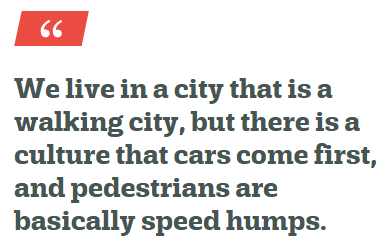
It became clear that we need to change our streets, making them safer, slower and more friendly for pedestrians and bicyclists. It's clear that we need to end our reliance on cars and built efficient transit systems. It's clear that we need to revise our licensing system to keep people who should not be allowed on roads, not to drive. And finally, it's pretty clear that we need to reform our police and ask them to truly "serve and protect", not to catch people on e-bikes or ticket jaywalkers. Probably the best summary of the problem was given by one of the NYC citizens who confronted Mayor de Blasio the day after the event:

Basically, we need another #NeverAgain campaign (hashtag used by Parkland shooting survivors to promote their call for change) and it shouldn't be the #VisionZero. In fact, there is no need to reinvent the wheel - the Dutch did that for us back in the 70's. Their "Stop de Kindermoord" seems very appropriate. Now it's time to implement it here in America and stop #murderbycar.

Wednesday, February 21, 2018

Is it over yet?

I've been taking a short break from blogging recently. In the time of my absence all sort of random things happen - a couple new mass shootings, a few hundred more people died in car collisions, a car flew into outer space, Boston went into a week of mourning after lost Superbowl, and finally - summer weather arrived - even though it lasted only 2 days. You know - just typical things you would expect to happen in February in United States.

Anyway, some things need to end so others can start. This winter I've been using a "new" bike for my daily work commute. It's actually my 10-years old "long-distance tourer", or whatever the most appropriate name is, just converted this time to a flat bar all-weather rig. This means - drop bars are gone, fenders are in, front rack is installed and a new drivetrain is now in place. I switched from 2x10 to 1x11. Less gears, same range and more than enough I need for this type of riding.

A post shared by Dr J (@drj.bbb) on
All this means that now I don't have a dedicated travel/touring/exploration bicycle anymore... but that's temporary. Something new is coming. Hopefully soon.

Meanwhile, I'm waiting for spring to come and I hope winter is not coming back because I've just replaced studded tires with normal ones.